
New Research: Why Your Pelvis Matters More Than You Think in Chronic Low Back Pain
A plain-language look at a 2026 study from the CBP NonProfit research team
If you’ve been dealing with chronic low back pain, you’ve probably heard a lot of advice: strengthen your core, stretch your hamstrings, improve your posture. But a new study published this year in Spine Open suggests something more specific is going on — and it starts with your pelvis.
What the researchers looked at
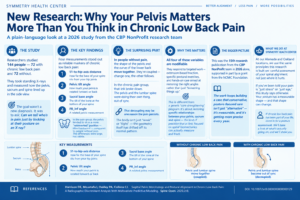
A team led by Dr. Deed Harrison, with co-authors Dr. Chris Colloca, Paul Oakley, and Dr. Ibrahim Moustafa, studied 144 people — 72 with chronic low back pain and 72 without. They took standing X-rays and measured how the pelvis, sacrum, and spine lined up in the side view.
The goal wasn’t to find a new diagnosis. It was to ask a simpler question: Can we tell who’s in pain just by looking at their posture on an X-ray?
What they found
Four measurements stood out as reliable markers of chronic low back pain:
- S1-to-hip-axis distance — how far the base of your spine sits from your hip joints
- Pelvic tilt angle — how much your pelvis is rotated forward or back
- Sacral base angle — the tilt of the bone at the bottom of your spine
- PR_inf angle — a related pelvic measurement
In the pain group, the pelvis tended to sit in a more “retroverted” position — tilted backward — compared to people without pain. And the differences were large, not subtle.
The part that surprised even the researchers
In people without pain, the shape of the pelvis and the curve of the lower back move together. They’re coupled — change one, the other follows. In the chronic pain group, that link broke down. The pelvis and the lumbar spine were doing their own thing, out of sync.
That decoupling may be one reason the pain persists. The body isn’t just “weak” or “tight” — the geometry itself has drifted off its normal pattern.
Why this matters for you
Here’s the encouraging part: all four of these variables are modifiable. They’re not fixed by genetics or age. They respond to targeted work — extension-based traction, specific postural exercises, and hands-on care aimed at restoring the right angles rather than just “loosening things up.”
This is different from a generic “core strengthening” program. It’s about restoring specific relationships between your pelvis, sacrum, and spine — the kind of precision that a clinic focused on spinal biomechanics can actually measure and track.
The bigger picture
This was the 15th research publication from the CBP NonProfit team in 2026 alone, supported in part by a grant from the NCMIC Foundation. The work keeps building a case that conservative, posture-focused care isn’t just “alternative” — it’s measurable, and it’s getting more precise every year.
What we do at Symmetry Health Center
At our Alameda and Oakland locations, we use the same principles this research is built on: careful assessment of your spinal alignment, not just where it hurts. If you’ve been told your pain is “just stress” or “just age,” this study says otherwise. Your posture has a measurable shape — and that shape can change.
If chronic low back pain has been part of your life, come in for a posture assessment. We’ll take a look at what’s actually going on, and we’ll show you.
Reference
Harrison DE, Moustafa I, Oakley PA, Colloca CJ. Sagittal Pelvic Morphology and Postural Alignment in Chronic Low Back Pain: A Radiographic Discriminant Analysis With Multivariate Predictive Modeling. Spine Open. 2026;2(4). December 2026. DOI: 10.1097/bn9.0000000000000129.
Direct link to the open-access study:
https://www.ovid.com/jnls/spineopen/fulltext/10.1097/bn9.0000000000000129~sagittal-pelvic-morphology-and-postural-alignment-in-chronic