
When a Rounded Back Is More Than “Bad Posture”: New Case Report on Scheuermann’s Kyphosis, Body Image, and Structural Rehabilitation
A newly published case report in Cureus (September 9, 2026) follows a 26-year-old man with Scheuermann’s disease whose main concerns were not severe pain, but posture, appearance, and quality of life. The authors—Giustra, Haas, Oakley, Betz, and Harrison—used Chiropractic BioPhysics® (CBP®) spinal rehabilitation and tracked results for 28 months.
At Symmetry Health Center in Alameda and Oakland, we regularly evaluate and treat thoracic hyperkyphosis and Scheuermann’s disease with the same evidence-based approach. This new report is worth sharing with our community.
The Patient’s Story
The young man presented with mild mid-back and low-back pain (1/10) and an Oswestry Disability Index of 16% (mild). His bigger problem was the visible rounded upper back and the way it affected how he felt about himself. The degree of thoracic hyperkyphosis had already disqualified him from enlisting in the U.S. Coast Guard (Cobb angle greater than 40°). Baseline quality-of-life scores (SF-36) showed reduced energy, emotional well-being, and general health. He was initially reluctant to remove his shirt for posture photographs.
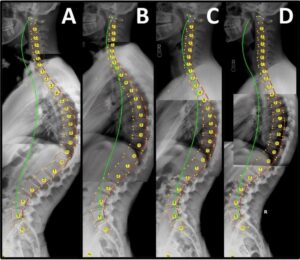
Baseline radiographs showed marked thoracic hyperkyphosis, including:
- Cobb T1–T12: 60.4°
- Maximum Cobb T4–L2: 82.4°
- Significant posterior thoracic translation and sagittal imbalance
The Treatment Approach
Care followed CBP® protocols: mirror-image exercises, full-spine adjustments directed at the measured misalignments, and mirror-image traction designed to reduce the thoracic curve and improve sagittal balance. He completed 36 in-office visits over three months, with re-evaluations at approximately 8 weeks, 3 months, 10 months, and 28 months.
What Improved—and What Held
Pain dropped to 0/10. The Oswestry Disability Index fell to 0% and stayed at 0% at the 28-month mark. SF-36 scores for energy/fatigue, emotional well-being, and bodily pain improved to levels that met or exceeded minimal clinically important differences and remained improved at long-term follow-up. The patient also reported greater confidence in his appearance and was more willing to expose his torso.
Radiographic changes were meaningful after the intensive phase. At 28 months some measures remained better than baseline (for example, maximum Cobb T4–L2 improved from 82.4° to 61.6° and T1–T12 from 60.4° to 46.2°), while sagittal translation showed partial loss of the mid-course correction. Overall, the authors described the structural and quality-of-life improvements as sustained.
Important Caveats
This is a single case report—Level V evidence. There was no control group. Body-dysmorphic concerns were discussed as a clinical issue, but a formal psychiatric diagnosis was not detailed. Not every radiographic measurement held its best post-treatment value. The report does not claim that CBP® is a proven cure for Scheuermann’s disease; it documents one patient’s measured response over more than two years.
Why This Matters for Patients in Alameda and Oakland
Many people with Scheuermann’s kyphosis or noticeable thoracic rounding seek care not only for pain, but because posture affects confidence, clothing fit, physical performance, and even career or military options. At Symmetry Health Center we use CBP® structural rehabilitation, mirror-image traction and exercise, and—when appropriate—ScoliBalance® and bracing options. Care begins with a thorough examination that includes posture analysis and, when indicated, standing radiographs so we can measure the curve and track change objectively.
If you or a family member has a rounded upper back, Scheuermann’s disease, or ongoing postural concerns, we invite you to schedule a free consultation. We will review your history, examine your posture and spinal alignment, and discuss whether a structural rehabilitation approach is appropriate for your goals.
Symmetry Health Center
Alameda Office
1708 Park Street, Suite 130
Alameda, CA 94501
(510) 769-0125
Oakland Office
6239 College Avenue, Suite 201
Oakland, CA 94618
(510) 654-2207
Website: symmetryhealthcenter.com
Reference
Giustra F, Haas JW, Oakley PA, Betz JW, Harrison DE. Sustained Improvements of Thoracic Hyperkyphosis, Body Dysmorphic Disorder, in a 26-Year-Old Male With Scheuermann’s Disease Using Chiropractic BioPhysics® Spinal Rehabilitation: A Case Report and 28-Month Long-Term Follow-Up. Cureus. 2026 Sep 9;18(9):e116012. DOI: 10.7759/cureus.116012